
As a child raised in North Carolina by adults raised in Macon, Georgia, I am no stranger to discrimination related to race. It wasn’t that racism was explicitly talked about at the dinner table; it was found more in the comments through the years from adults about the potential actions of groups of people, issues related to ‘mixing races’ in relationships, and even responses to things that took place in the news. As a white male raised in a southern culture, I seldom found myself in spaces where things needed to be whitewashed because everything was already white.
Today, we often believe that because civil rights were something we “figured out” decades ago, racism has gone by the wayside, and that people just need to “get past” their issues, and that racism is just a construct used to push one political agenda. This is why we pretend it does not exist when it pops up in our churches, our businesses, the grocery store, and even the highest office in our land.
The issue with that is that we are denying something very real and very evil because, at its core, it denies the image of God in another person.
A few years ago, I traveled with several campus ministers and a group of college students to Atlanta, Georgia, to serve during Spring Break. Our time there focused on two closely connected realities: poverty and race. Throughout the week we served, listened, learned history, and heard directly from people whose lives are shaped every day by racial injustice. We talked about discrimination, the history of the city, and the tension that still exists beneath the surface. We heard stories that were not abstract, but personal and painful.
Each night after dinner, we gathered together to talk about what we had seen and experienced. As the week went on, the conversations became more honest and more difficult. By the final night, the weight of what we had encountered was heavy in the room.
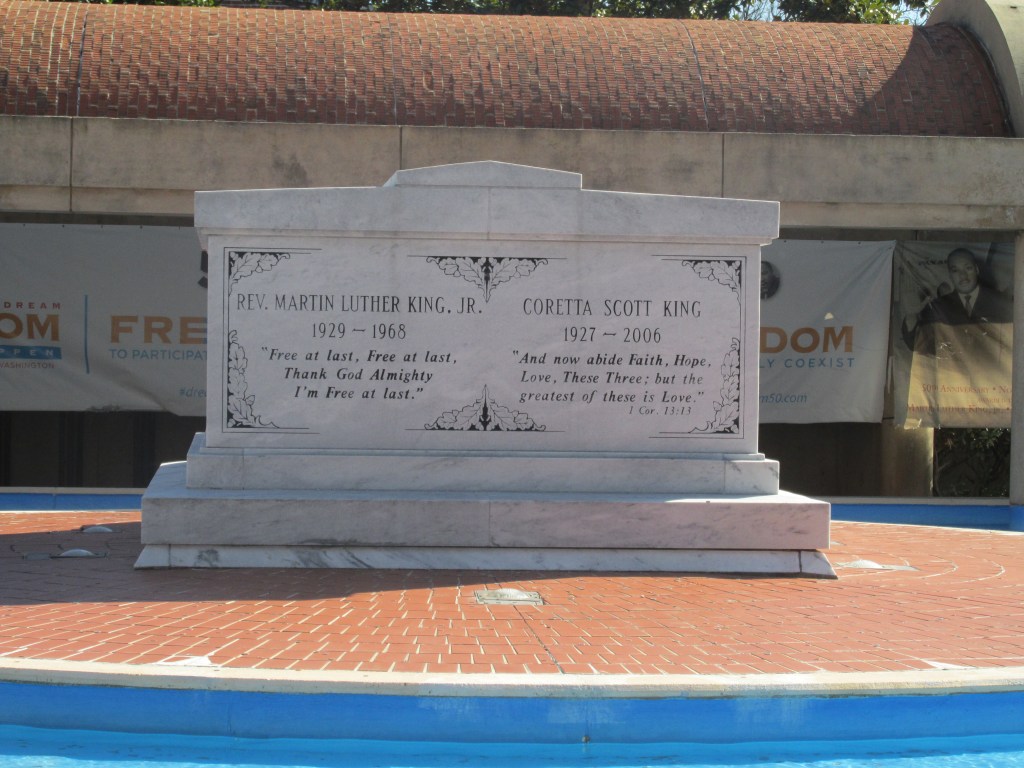
Earlier that day, we had visited the Martin Luther King Jr. Center for Nonviolent Social Change. Walking through the exhibits, I was struck by images of hatred that many people assume belong to the past. I felt anger and sadness as I moved from room to room. It was heartbreaking to see how fiercely people fought to deny the humanity of others, how willing they were to ignore the sacred worth of the person standing in front of them.
What made it even harder was realizing how much of that denial still exists.
That evening, one of the questions we asked was simple: “How has racism affected you, or how have you seen it affect others?” As students shared their stories, a common theme emerged: racism does not just wound individuals. It shapes neighborhoods, schools, opportunities, and expectations. It teaches people who belong and who do not. It quietly tells some people that they must work harder to be seen as fully human. Racism works by reducing people to categories, and it takes something God created as beautiful and diverse and turns it into a tool for exclusion. When we stop seeing a person as a bearer of God’s image, it becomes easier to justify fear, suspicion, or indifference. That is how racism survives: it grows wherever dignity is withheld.
Scripture tells us that every person is created in the image of God. Not some people. Not people who look like us, worship like us, or live near us. Every single person. The things about racism? It directly contradicts this truth as it declares that some images matter more than others, that some lives carry more weight, and that some suffering is easier to ignore.
Standing at the King Center, listening to Dr. King’s words, I was reminded that his dream was never just about changing laws. It was about restoring dignity. When he spoke of a day when all of God’s children would join hands, he was calling the world to recognize what it had long refused to see, that justice begins with honoring the image of God in every human being. Racism deforms the world because it trains us to look past one another instead of truly seeing one another. It damages communities. It limits compassion. It teaches us to accept inequality as normal. And it persists when it goes unnamed.
We have a responsibility to tell the truth about this. Racism is not just a personal flaw or an unfortunate misunderstanding; it is a moral failure that demands repentance, courage, and action. If we are to move forward, we must be willing to look deeper than surface differences and refuse the lies that have shaped our common life for far too long.
We have a long way to go, but as Dr. King reminded us, we cannot turn back. The work of justice calls us to keep walking, to keep naming what is wrong, and to keep trusting that a world rooted in dignity and freedom is still possible.
As the late John Lewis wrote in his book, Across that Bridge: A Vision for Change in the Future of America: “Ours is not the struggle of one day, one week, or one year. Ours is not the struggle of one judicial appointment or presidential term. Ours is the struggle of a lifetime, or maybe even many lifetimes, and each one of us in every generation must do our part.”

Leave a comment