
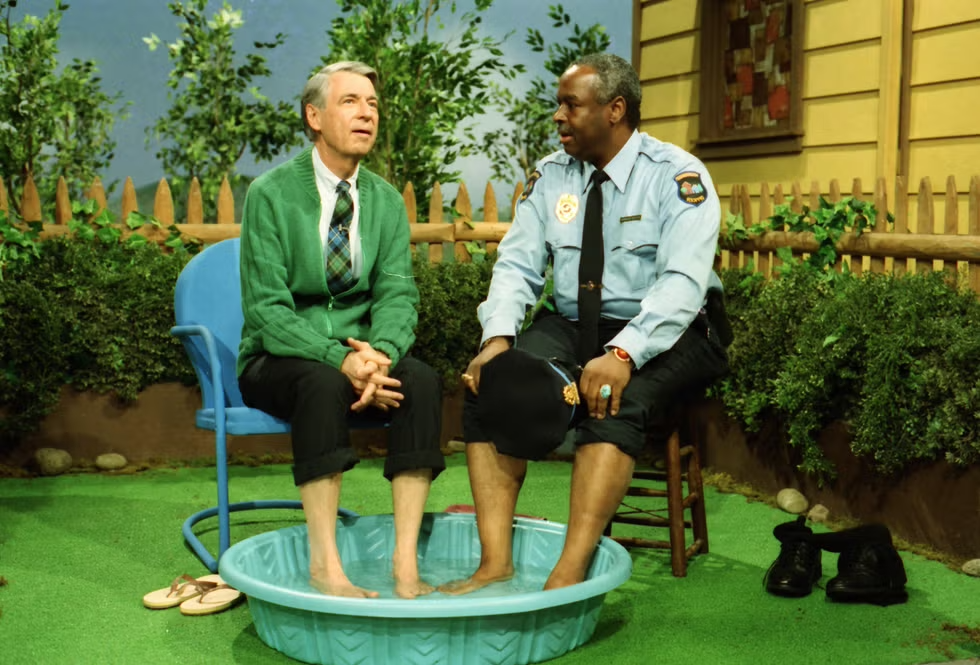
Though the Civil Rights Act was signed by President Johnson in 1964, by 1969 swimming pools in the American south were still divided by segregation–– and nothing seemed to be stopping it. Hatred reigned high and even led to swimmers being arrested and, worse, having acid poured into the pool water to force them out when they jumped in together.
It was at a pivotal point in this on-going saga that the leading expert on kindness and neighborly love stepped in.
Even today, Fred Rogers is known for his gentle way of sharing love and grace in ways that made you feel like the world might just be ok. He didn’t often wade into the political sphere on his TV show, Mr. Rogers’ Neighborhood but, when he did, it was often done in the grace-filled and kind way that he did everything.
Biography.com recounts Rogers’ response to the on-going segregated swimming:
“Rogers knew that pools continued to refuse entry to Black people in 1969 and that racial tensions were rising — Martin Luther King Jr. had been assassinated a year earlier. So he sent a deliberate message on the May 9, 1969, episode of Mister Rogers’ Neighborhood. During the show, Rogers asked Officer Clemmons, a Black police officer played by François Clemmons, if he’d like to cool his feet with Rogers in a children’s wading pool. Clemmons initially declined the invitation, noting he didn’t have a towel — but Rogers said Clemmons could share his.
The actions in episode 1065 weren’t complex: two men took off their shoes and socks, rolled up their pants and then swished their feet together in a shallow pool on a hot day. But Rogers and Clemmons demonstrated that a Black man and a white one could peacefully share the water. When Clemmons had to go, he used Rogers’ towel to dry his feet, as promised. Rogers left the pool directly after Clemmons and proceeded to use the same towel. Their casual intimacy exposed the bigotry of denying Black citizens access to pools, or any other place in society.” 1
Amid the anger and down-right meanness of segregation, Mr. Rogers sought to teach something that he’d learned from his Presbyterian upbringing: that love of neighbor was not just the right thing to do, it was the way we could build a kinder world. For Fred Rogers, kindness was not just something to do when we feel like it, or when faced with someone we like, it is a core way we make the world better. As he once said:
“There are three ways to ultimate success:
The first way is to be kind.
The second way is to be kind.
The third way is to be kind.”
While there is certainly a case for the sainthood of Mr. Rogers, his belief in this kindness was not original to him.
His faith was grounded in the teachings of a first-century rabbi named Jesus who’d done amazing things as he showed kindness to a world that was anything but kind.
At the time of the Apostle Paul’s letter to the churches in Ephesus, the Christians there found themselves surrounded on all sides by people who were hostile to their faith. These Gentile Christians were former pagans who worshipped many gods before coming to follow Jesus.
Their neighbors were not too excited about this and they faced persecution.
Paul writes to them to try and encourage them to keep their faith as they seek to grow as disciples of Jesus.
He encourages them to love the world around them but to start by loving one another through the ways they exist together inside their church community. In Ephesians 4:32 he says:
“Be kind and compassionate to one another, forgiving each other, just as in Christ God has forgiven you.”
He knew this would be hard for these believers, but he also knew that kindness was a core part of following Jesus and that they would need to love one another through how they treated each other if they were ever going to be able to love their neighbors like Jesus had called them to do.
He also tells them why they should show love and kindness to one another and their neighbor: because of the gift they’d received through Christ.
Jesus, Paul says in Ephesians 1:3-14, has given them redemption, forgiveness, grace that overflows, and a peek into the mysterious will of God to restore the world.
God is not out there but in here. God is close and because of this, they were the temple in which God’s powers of redemption, forgiveness, grace, and restoration lived.
More than that, Paul tells these former pagans that the Jesus of those things lives within them through the guidance of the Holy Spirit. In these words, Paul is trying to show them that they are vessels of these things in their world because there is no place where Christ stopped and they began. They were to be Christ to the world around them which meant living as he did.
So, Paul says, start by showing compassion and kindness to one another.
It’s no secret that the church of today has failed at this task–– inside and outside of our walls. Christians are not often known for their kindness, but instead for their meanness. As one meme so eloquently puts it:
“When you tell them to be the salt of the earth and they decide to be salty to everyone on earth instead.”
It’s not that Christians can’t stand for what they believe but rather that Christians have stood on those beliefs in anything but kindness and compassion–– and that’s true ‘out there’ as much as in our communities of faith.
The truth is that nothing happens in a vacuum. Christians didn’t just become known for being salty overnight. This is something that has come from decades of continued ‘meanness’ on the part of Christians and a church that is more known for what we’re against than what we’re for. Many Christians say that they know the command to love their neighbor but, at the first sign of division, they do anything but love.
Some might say: “well, Lawrence, it’s not my fault. They are mean to me.”
To that, I would point out that Jesus didn’t say: “when someone punches you, give them your strongest uppercut.” No, he said to “turn the other cheek before you return hatred with hatred or meanness with meanness.”
But, we still struggle with being salt in a world that we feel is salty toward us, don’t we?
To give direction in that, I would say what Paul would say: “draw your strength from the Spirit that is within you because of all the amazing things Jesus has done for you. Then, turn that strength out to the world with compassion and kindness.”
Kindness is not easy, especially in a country as divided as ours. I know that this fact is why some of you are already thinking: “but I have to speak out. I have to stand for what’s right.”
To that I would say: “yes, and, do it in kind ways.”
Christians are not called to stay quiet on things that matter, but they are called to love their neighbor even in standing up. So, when you do stand up for what you believe: don’t do it in ways that make someone less. Don’t do it in ways that accuse. Don’t do it in ways that divide further.
Have conviction, but don’t sting people with it. Be kind.
Before you speak or post on social media stop and ask yourself: does this thing I’m about to do or say exude the lavished grace of Christ that lives within me? Does this communicate a standing against what is wrong in the world, while also showing Christ to it?
Don’t separate your faith from your posting and speaking. Let it guide you to bring others to the way of Jesus. Help the world to know that Jesus has done some amazing things and wants all of the world–– “all things” Paul says–– to take part in it. Let everyone know they have a place in the adoptive family of Christ who loves them and sees them as beloved.
Church, in a world that separates, belittles, and hates, be like Jesus. Be like Fred Rogers. Be a good neighbor by being kind, even when others do not reciprocate it. Offer grace when it’s hard. Listen when you don’t agree. Have hope that their world, and yours, can be bettered if we focus on being salt that adds flavor to the world instead of salty that makes it worse.
As Mr. Rogers once said:
“Imagine what our neighborhoods would be like if each of us offered, as a matter of course, just one kind word to another person.”
Imagine!
“There are three ways to ultimate success:
The first way is to be kind.
The second way is to be kind.
The third way is to be kind.”
Amen.
_______________
This post was adapted from a sermon I delivered at Benson Baptist Church on Sunday, July 14, 2024. The sermon focused on the spiritual fruit of kindness (Galatians 5) and Paul’s words to the Christians at Ephesus in Ephesians 1:3-14.

Leave a comment