
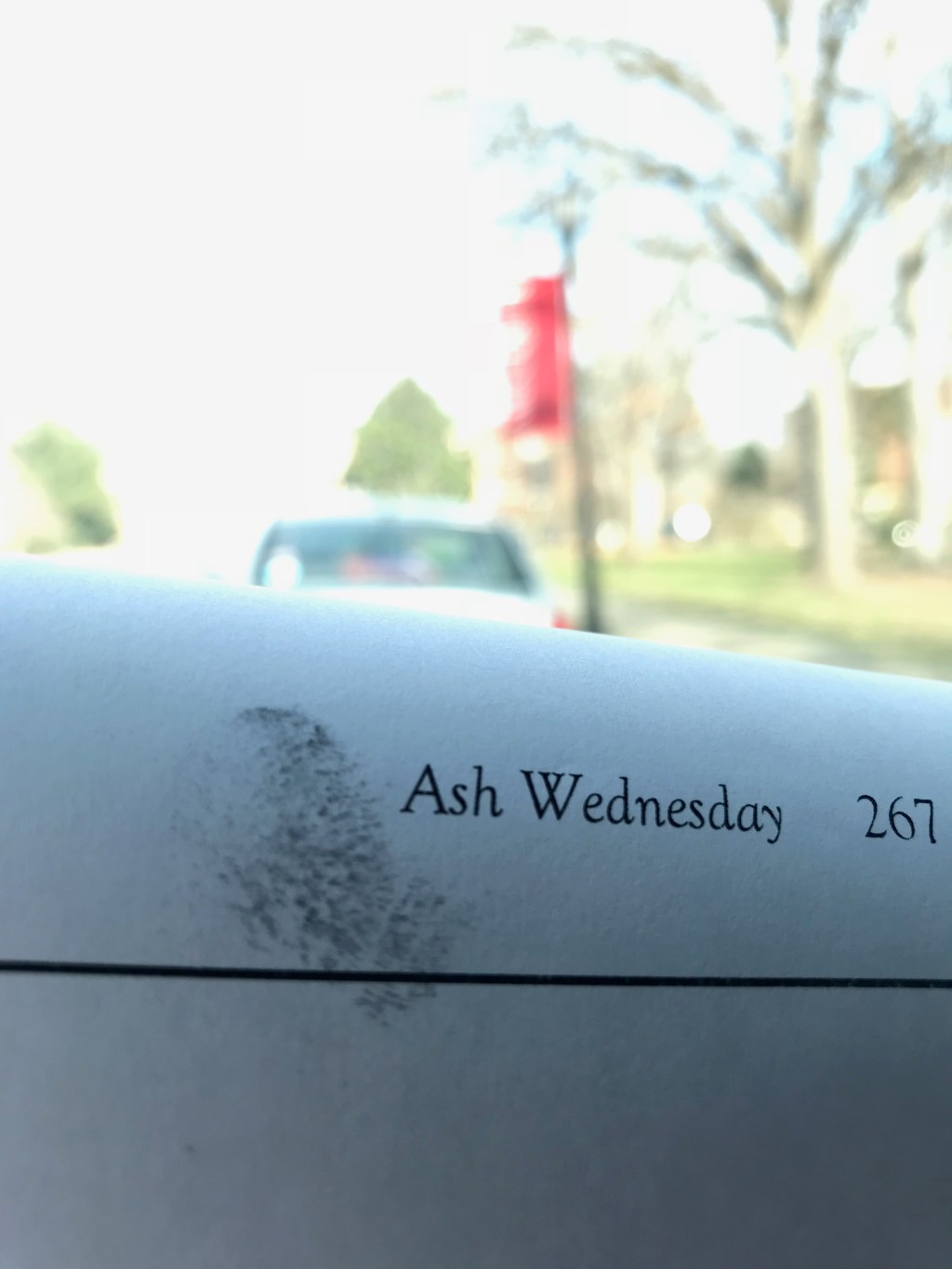
 Today is an odd day.
On the one hand, today is Ash Wednesday: a day we focus on the finality of death, the realization that our lives are short and headed toward an end. But, juxtaposed against that, is that today is also Valentine’s Day: a day we celebrate the love in our lives through delicious chocolate, beautiful flowers, and sappy Hallmark cards.
I think, if we’re going to really embrace the realities of this day, we have to first admit that, in life, we’re kind of always standing at the intersection of death and love. Day-in and day-out, we’re faced with the realities of death and the promises of love. We can’t avoid it. But how to spend a few minutes focused on it now?
I think a great place to start is in one of the most famous stories from the Bible. It’s found in John 8:2-11, and is a passage that many of you have heard a few times before. It’s the story of Jesus and the woman caught in adultery, and baring any Valentine’s Day parallels you may have in your mind right now, is a good place for those of us to start if we’re to decide how to face the intersection at hand. It says this:
2 Early in the morning he came again to the temple. All the people came to him and he sat down and began to teach them. 3 The scribes and the Pharisees brought a woman who had been caught in adultery; and making her stand before all of them, 4 they said to him, “Teacher, this woman was caught in the very act of committing adultery. 5 Now in the law Moses commanded us to stone such women. Now what do you say? They said this to test him, so that they might have some charge to bring against him.”
For those of you that know the rest of the story, push what happens next to the back of your mind. For, if we’re to fully grasp what happens next, I believe we need to face the realities of what could have happened. We have to first face the death road.
In Jesus’ day, according to the law found in Leviticus 20:10: “death is fixed as the penalty of adultery.” This means, that this woman’s sentence was decided the minute she was pulled from her bed and dragged out into the street. As soon as she was caught, she was to be taken to the edge of town and be crushed by stones until dead. If we were to stop our Gospel passage here, this is exactly what would have happened.
It is, of great importance, to note that the man she was caught with is not dragged out into the street with her. Like the archaic death sentence she faces for what she’s done, so too, is the way she is alone in facing it. The important thing to remember is that today, two thousand years later, we need to see that such threads of inequality and injustice flow through the way we treat women in society today. We cannot ignore the past, for the future cannot continue to be as it was.
But for this story and time, people formed into a mob, raising stones above their head in the name of God, would have hurled them at her with all of the force they could muster:
“For your poor decisions.” BOOM.
“For your seduction of the man.” BOOM.
“For your rejection of God.” BOOM.
“For your sin which is greater than my own.” BOOM.
“For your worthlessness.” BOOM.
“For your lack of purpose and deserving of life.” BOOM.
One by one, the rocks fall, until bloodied and broken she lay dead. A victim of an unjust system held up by those claiming to represent the holy and just God.
Yes, as we face this intersection and the death road that lays before us, we cannot ignore the possible plight of this woman. Standing, likely without clothing, in the street, she hears the Ash Wednesday refrain we can hear ourselves every single day: “from ashes, you have come to ashes you will return.”
- When the future is unclear and stress, depression, and self-doubt consume us: from ashes you have come, to ashes you will return.”
- When those we love and care for pass away sooner than we would desire: from ashes you have come to ashes you will return.
- When people live without the basic necessities of life that could be available to them if not for greed and selfishness: from ashes, you have come, to ashes you will return.
- When marching in the street becomes the only way for one to have their voice heard because it has been stomped out and reduced to almost nothing by a system set up to do just that: from ashes you have come to ashes you will return.
- When war literally rips through homes, families, and bodies: from ashes you have come, to ashes, you will return.
- When those faced with death are turned away from a chance at safety and life: from ashes you have come, to ashes, you will return.
- When nothing seems hopeful and we feel like we have no choice but to accept these things as they are because it is safer and more comfortable to do so: from ashes you have come to ashes you will return.
No, we cannot ignore that death is a part of this life. We cannot ignore that we are but a ripple in the ocean of those who have lived, and will live.
But, today is not just Ash Wednesday. Today is not just a day of coming from and returning to ash. Today is also a day focused on love. With that in mind lets continue our passage:
Jesus bent down and wrote with his finger on the ground. 7 When they kept on questioning him, he straightened up and said to them, “Let anyone among you who is without sin be the first to throw a stone at her.” 8 And once again he bent down and wrote on the ground. 9 When they heard it, they went away, one by one, beginning with the elders; and Jesus was left alone with the woman standing before him. 10 Jesus straightened up and said to her, “Woman, where are they? Has no one condemned you?” 11 She said, “No one, sir.” And Jesus said, “Neither do I condemn you. Go your way, and from now on do not sin again.”
I can’t imagine what this woman must be feeling at the moment she is pushed in front of Jesus by this mob of religious leaders. She must have thought that her destination was execution, but now she’s facing a judge instead. I imagine her quiet sobs filling the moments of bated breath as Jesus was faced with the power of judgment. I imagine her body shaking with fear and sadness as she silent looked toward the ground awaiting her fate. “What would this Rabbi say? It was, after all, the expectation of a Rabbi to follow the ancient Law of God.”
I imagine her surprise as, instead of an immediate reply to her accusers, the Rabbi bends down into her line of sight. Moments before, with her eyes downcast, awaiting a response, all she would have seen is Jesus’ feet. Now, in a surprising act, Jesus bends down to the ground where she can see him and begins writing in the sand.
What did he write? For centuries people have debated exactly that question. No one, of course, has the final answer and it is not given here. For me, and likely for the woman, what was written didn’t matter. For me, and for her, the importance is found in the moment the lofty judge and jury slides down, not to her level, but beneath it. It is found when Jesus does not immediately say what is expected but, instead quietly moves into her sight line and begins to write in the dirt.
For a few moments, all present could have heard a pin drop. For those in the mob, quiet wonder at why he didn’t immediately uphold the Law and condemn her. For the woman, silent puzzlement at what his reflection could mean for her life.
Then, in a moment no one could see coming, he rises back to the level of the accusers, meets their gaze and says some of the most powerful, challenging words ever recorded: “let the one of you that has never messed up, whose life is worth more than this woman standing before us, throw the first stone to bring the execution.”
Then, as the woman’s eyes begin to widen in surprise, Jesus once again returns to her sight line and begins writing in the sand.
One by one, I’d imagine unknown to the woman, the accusers begin to slip away. Minutes tick by as the woman cringes expecting the first stone to graze her body, when Jesus straightens, drawing her eyes upward from her shame to the restorative power of his gaze.
“Where are your accusers?” Jesus asks. The woman, I think likely for the first time since being dragged into Jesus’ presence, turns to face those who’d brought her. Fear melts into confusion as she turns to see no one there. Confusion turns into wonder as she turns back to Jesus, wondering if he might be holding a stone.
Instead, she finds no judgment, no execution, no accusation. She only hears some of the second most powerful words ever recorded: “Then neither do I condemn you, go and sin no more.” In one short sentence, Jesus provides restoration, promise, life, and yes, love.
Not a chocolate, flowers, or cards kind of love– but a love that has given her a second chance, a deep purpose, a promise, and a call to go and share that love with those around her.
This woman’s story is a great example of our own call to journey the road of love in a world that only sees the pathway of death. To this woman, and to a world that desperately needs a word of hope, Jesus says: “from ashes, you have come, yes… but…”
To a world that only sees death, Jesus calls us to remember that there is so much life between the ashes. Jesus’ actions here, remind us that there is still some light, even in the face of death.
Anglican Archbishop Emeritus, Desmond Tutu, illustrates this point well when he says: “Do you remember what God told Moses? He [God] said, ‘I have seen the suffering of my people. I have heard their cry. I know their suffering and am come down to deliver them.’ Our God is a God who knows. Our God is a God who sees. Our God is a God who hears. Our God is a God who comes down to deliver. But the way that God delivers us is by using us as partners, by calling on Moses, and on you and me.”*
So, today, as you receive these ashes and hear the familiar refrain, do not despair. For the journey of Lent that begins with Ash Wednesday: the reminder of death that comes at the conclusion of this life, ends with Easter Sunday, the reminder that there is nowhere–and no one– that is outside the love of God seen through Jesus–and through us as we journey this constantly intersecting road.
As you receive these ashes, may you know that each swipe on your forehead is a symbol of death AND a reminder of love– both the love found in God and the love we’re called to share with the world.
From ashes, you have come, yes… but…
Amen.
_____
*From: “God Has A Dream: A Vision of Hope for Our Time,” by Desmond Tutu.

Leave a comment