
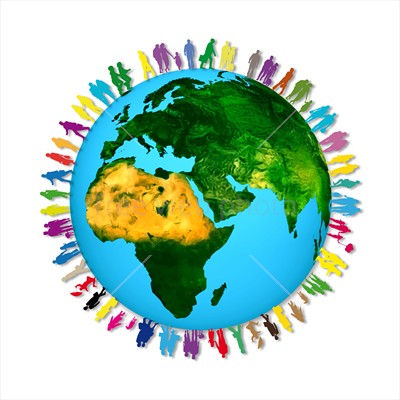
“While Jesus was still talking to the crowd, his mother and brothers stood outside, waiting to speak to him. Someone told him, ‘your mother and brothers are standing outside waiting to speak to you.’ He replied to him, ‘who is my mother, and who are my brothers?’ Pointing to his disciples, he said, ‘ Here are my mother and brothers. For whoever does the will of my Father in heaven is my brother and sister and mother.’” – Matthew 12:46-50
Family has always been a touchy subject for me. Growing up I would often find myself envying the TV families who seemed so perfect, so together. I would long for the father I never had growing up, the ‘normal’ everyday smiles and relationships they had. Instead, being the oldest of five raised mostly by a single mother, I stayed busy living a life full of responsibilities and pressures I could never imagine making the good plot line for the children of those TV shows.
As a family, we experience both good times and bad times together. Holidays where it seems all we do is bicker and events where we can’t stop laughing as we reminisce. At the end of all of it we still love each other but only with the realization that each of us is different and each of us has a different starting point as we seek to define what family means to us.
As I think through these words of Jesus from Matthew 12, I can’t help but wonder if my understanding of family might be shifting a bit.
I just finished chapter 2 in Archbishop Desmond Tutu’s book “God Has A Dream: A Vision of Hope For Our Time.” In this beautiful chapter, Tutu seeks to point out how, in our humanity, we are made family with one another. He explains that regardless of ethnicity, socio-economic standing, religion, location, etc., God has created us and in our being created, we share a unique bond with one another- a bond that, if understood correctly, would change how we approach each other.
If a stranger (or even an enemy) is my brother or sister, how much harder is it to live life a certain way with them? How can we approach situations the same way, offer grace the same way if we are no longer approaching an enemy, but rather a sibling? Approaching not an outsider, but a member of the community that is our family.
I’ve spent the last few years seeking out the meanings of community as I’ve served as an Intentional College Community coordinator and have constantly read and experienced that it is something we each are created for. “We are not meant to do life alone,” Shane Claiborne notes in “The Irresistible Revolution.”
Yet, the Archbishop has gotten me thinking about community and family on a whole new level. You see, it is one thing to say “we’re all created in the image of God,” and quite another to acknowledge that this fact makes us all family.
Tutu does not draw attention to the Matthew passage quoted here, but it jumped into my mind as I read his chapter. You see, Jesus does not dismiss Mary or his brothers as not being family, he simply (or perhaps not so simply) points to those around him (his ‘disciples’ here are more likely represented by the larger crowd that was always near him) and states that they are all his mother, brother and sister. “He who does the will of my Father in heaven,” he says.
In light of Tutu’s thoughts on all of us being family through our common fellowship as creations of God (our humanity), I can’t help but think Jesus is looking around him and seeing those people as God does- beautiful creations inexplicably linked together through their humanity, linked to him, through his humanity.
Perhaps, doing the will of the Father is not the “do this or do that” rule following mentality we often argue, but rather just recognizing the humanity that exists within us all, humanity that binds us together as members of one big extended family.
So often we dehumanize those we disagree with, but perhaps Jesus is showing us that, when we see them as family, we recognize something deep within them, and us, that connects us to one another. After all, it’s harder to dehumanize someone you see as your mother or brothers. Tutu rightly describes this concept as ‘radical,’ and I agree with him. This is contrary to the way society wants us to approach one other. Of course, Jesus never promised doing the will of the Father would be easy…
Maybe to do God’s will is to see the world as God does and to, like God, extend the inexhaustible grace and love that truly can only ever exist in the confines of family. Maybe it’s also to not shy away from the moments we disagree, but rather to see the beauty in moving forward and living life together, irregardless of our different ways of understanding.
What does this mean for us today? It means that no matter where we are where we come from, we have a family. It means that we should never look at a stranger the same way again. It means, quite simply, that everyone around you is your mother and brother and sister, all linked together in the beauty that is God’s creation.
Perhaps, in order to fully live into God’s will and purpose we must first redefine what family is to us. No, it won’t always be easy: there will he holidays of bickering mixed in with stories of joy. There will be moments of disagreement and moments of unified determination. Whatever this full family may look like, maybe it’s time we all woke up and realized that family is not just found in a bloodline. Maybe, just maybe, in light of our humanity, family is something deeper, something much more beautiful.
May we find the courage to seek out this knowledge and, in doing so, hopefully find ourselves all along the way doing the will of the Father that unites us all.
Welcome to the family.

Leave a comment